20 Jun 2026
If you're planning to apply for ISO Certification in Haryana, one of the first questions you'll have is: What documents are required for ISO Certification in Haryana? Having the right paperwork ready can make the certification process faster, smoother, and more efficient.
Whether you run a manufacturing unit, an MSME, a startup, an export company, or a service-based business, proper documentation is the foundation of a successful ISO certification process. It demonstrates that your organization follows standardized processes, complies with applicable regulations, and is committed to continual improvement.
In this comprehensive guide, we'll explain the documents required for ISO Certification in Haryana, why they matter, how they vary by ISO standard, and how Legal Way Certification helps businesses complete the process with confidence.
ISO (International Organization for Standardization) develops internationally recognized management system standards that help organizations improve quality, safety, environmental performance, information security, and customer satisfaction.
An ISO certificate verifies that your business has implemented a management system that meets the requirements of a specific ISO standard. During the certification process, auditors review your organization's documentation, processes, and records to confirm compliance.
Preparing the correct ISO Certification documents in Haryana is one of the most important steps toward successful certification.
Documentation provides evidence that your organization has established and follows standardized procedures. It enables auditors to verify that your management system is effective, consistent, and aligned with the chosen ISO standard.
Proper documentation helps businesses:
> Demonstrate compliance with ISO standards
> Improve internal process consistency
> Reduce operational risks
> Enhance quality management
> Support successful certification audits
> Build customer confidence
> Maintain regulatory compliance
> Promote continual improvement
Well-organized records also make surveillance and renewal audits much easier.
The exact requirements depend on your business size, industry, and selected ISO standard. However, most organizations need the following documents.
Your organization should provide proof of legal existence, such as:
> Certificate of Incorporation
> Partnership Deed
> LLP Registration Certificate
> MSME/Udyam Registration (if applicable)
> Shop & Establishment License (if applicable)
These documents establish your business identity during the certification process.
Most businesses applying for ISO Certification in Haryana are expected to provide their GST Registration Certificate, where applicable.
This helps verify business operations and legal compliance.
A copy of the business PAN card is generally required as part of the verification process.
Accepted documents may include:
> Electricity Bill
> Rent Agreement
> Property Tax Receipt
> Utility Bill
> Lease Agreement
The address should match your registered business location.
Auditors often request an organizational chart showing:
> Management hierarchy
> Department structure
> Employee responsibilities
> Reporting relationships
This helps assess management responsibilities and accountability.
A clear description of your organization's activities is essential.
This should explain:
> Products or services offered
> Business operations
> Target markets
> Locations covered
The scope determines which processes are included within the ISO management system.
Organizations should maintain:
> Employee list
> Roles and responsibilities
> Training records
> Competency records
> Attendance records (where applicable)
These records demonstrate that employees are qualified to perform their assigned duties.
One of the most important ISO Certification requirements is documented business processes.
These may include:
> Standard Operating Procedures (SOPs)
> Work Instructions
> Process Flow Charts
> Quality Procedures
> Department Procedures
Proper process documentation improves consistency and reduces operational errors.
Many organizations prepare a Quality Manual that outlines:
> Company objectives
> Quality policy
> Organizational processes
> Process interactions
> Management responsibilities
Although modern ISO standards are more flexible, maintaining a quality manual remains a good practice for many businesses.
Your organization should maintain documented policies, such as:
> Quality Policy
> Environmental Policy
> Health & Safety Policy
> Information Security Policy
> Food Safety Policy
Policies should align with your selected ISO standard and be communicated to employees.
Modern ISO standards emphasize risk-based thinking.
Businesses should document:
> Risk identification
> Risk evaluation
> Control measures
> Opportunity assessments
> Corrective actions
Risk documentation supports continual improvement and compliance.
Before certification, organizations should conduct an internal audit to evaluate the effectiveness of their management system.
These reports help identify:
> Non-conformities
> Areas for improvement
> Corrective actions
> Process effectiveness
Senior management should periodically review the management system.
Typical records include:
> Meeting minutes
> Performance reviews
> Customer feedback
> Audit findings
> Improvement decisions
These records demonstrate leadership involvement.
> Quality Policy
> Quality Objectives
> Customer Complaint Records
> Process Documentation
> Internal Audit Reports
> Corrective Action Records
Additional documents include:
> Environmental Aspects Register
> Waste Management Records
> Pollution Control Measures
> Legal Compliance Register
> Environmental Objectives
Required records may include:
> Hazard Identification
> Risk Assessments
> Safety Procedures
> Incident Reports
> Emergency Preparedness Plans
Food businesses should maintain:
> HACCP Plans
> Food Safety Procedures
> Supplier Approval Records
> Cleaning Records
> Temperature Monitoring Logs
Information security organizations typically require:
> Information Security Policy
> Asset Register
> Risk Assessment Reports
> Access Control Policy
> Incident Management Procedures
Many businesses delay certification because of documentation errors.
Avoid these common mistakes:
> Incomplete documentation
> Outdated policies
> Missing employee records
> Poor document control
> No internal audit
> Undefined business scope
> Lack of management review records
> Missing corrective actions
Working with experienced ISO consultants helps eliminate these issues before the certification audit.
The documents required for ISO Certification in Haryana apply to businesses of all sizes, including:
> Manufacturing companies
> MSMEs
> Startups
> Exporters
> Educational institutions
> Hospitals
> Logistics companies
> Construction firms
> IT companies
> Service providers
> Food processing units
> Engineering industries
Regardless of your industry, organized documentation improves audit readiness and supports long-term compliance.
At Legal Way Certification, we simplify the entire documentation and certification process. Our experienced consultants help businesses across Haryana prepare accurate documentation, implement management systems, and successfully complete certification audits.
Our services include:
> ISO documentation support
> Complete certification guidance
> Internal audit assistance
> ISO 9001, ISO 14001, ISO 45001, ISO 22000, and ISO 27001 consulting
> Affordable certification packages
> Fast turnaround time
> End-to-end compliance support
We serve businesses throughout Haryana, including Gurugram, Faridabad, Sonipat, Panipat, Karnal, Rohtak, Hisar, Ambala, Jhajjar, Yamunanagar, Bahadurgarh, and other industrial regions.
> ISO 45001 Certification
> Blog
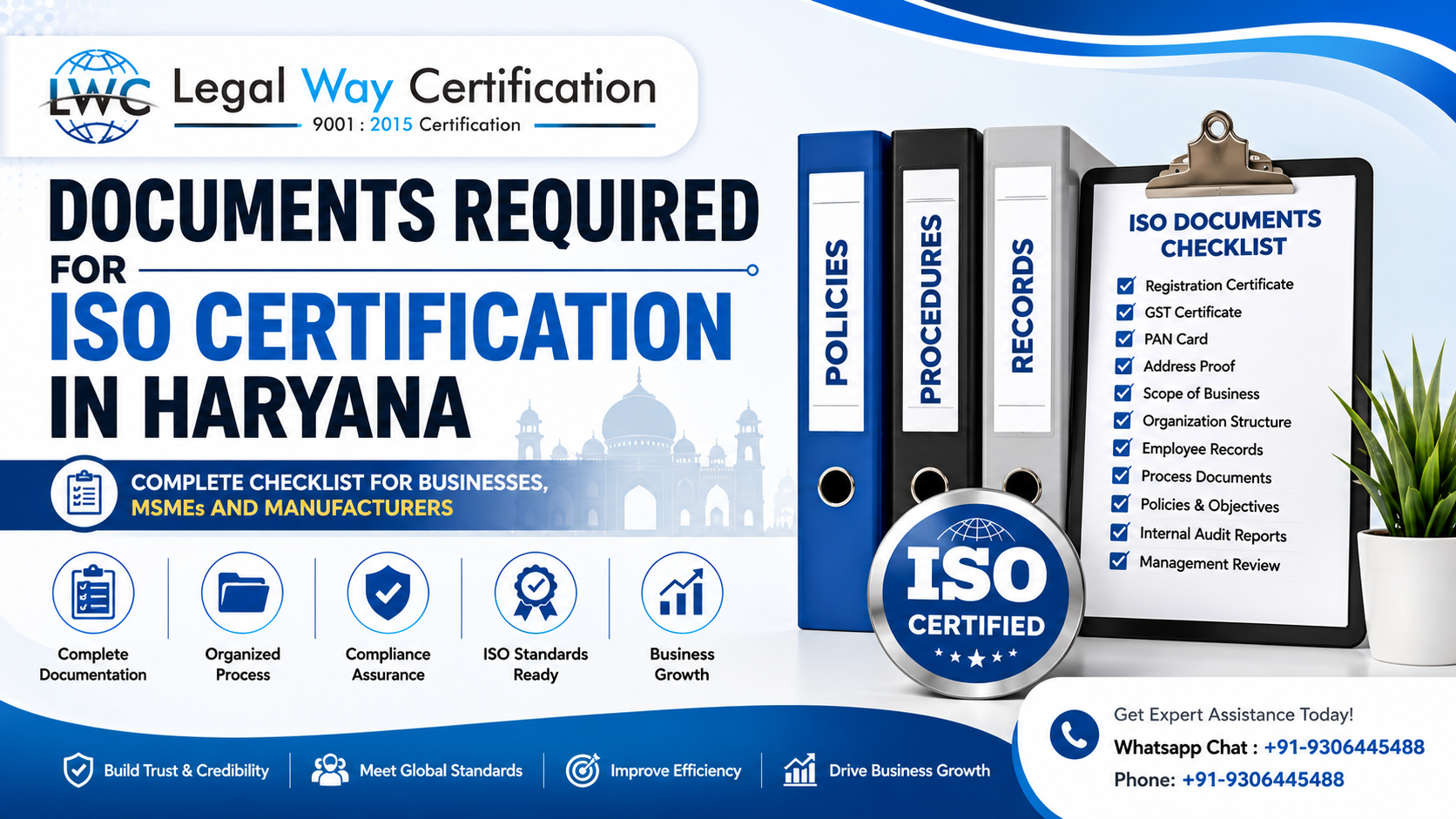
Most businesses need their registration certificate, GST certificate (where applicable), PAN card, address proof, organizational structure, business scope, employee records, process documentation, policies, internal audit reports, and management review records.
Yes. While basic business documents are common, standards like ISO 14001, ISO 45001, ISO 22000, and ISO 27001 require additional records related to environmental management, occupational health and safety, food safety, or information security.
Yes. MSMEs and startups can apply for ISO certification by providing the required legal documents along with management system documentation appropriate to their business activities.
GST registration is generally required if your business is legally obligated to have one. Businesses without a GST requirement should discuss their specific situation with an ISO consultant.
The best approach is to work with experienced ISO consultants who can help create, review, and organize your documentation according to the selected ISO standard, ensuring a smooth certification audit.
Preparing the documents required for ISO Certification in Haryana is a crucial step toward achieving internationally recognized compliance and improving your organization's performance. Complete, accurate, and well-maintained documentation not only supports a successful certification audit but also enhances operational efficiency, customer trust, and business credibility.
Whether you're an MSME, manufacturer, exporter, startup, or service provider, investing time in proper documentation lays the foundation for long-term success and continual improvement.
Ready to obtain ISO Certification in Haryana without documentation hassles?
Legal Way Certification provides expert guidance from document preparation to successful certification.
📞 Phone: +91-9306445488
📲 WhatsApp Chat: +91-9306445488
Contact our experts today to receive personalized assistance, affordable certification packages, and end-to-end support for your ISO certification journey.
Most organizations need business registration documents, GST certificate (if applicable), PAN card, address proof, organizational chart, business scope, employee records, documented procedures, quality policies, internal audit reports, risk assessments, and management review records. Additional documents depend on the specific ISO standard, such as ISO 9001, ISO 14001, ISO 45001, ISO 22000, or ISO 27001. This structured documentation helps businesses demonstrate compliance during the certification audit and supports continual improvement.
ISO Stands for Legal way Certification. ISO is an independent, non-governmental international organization with a membership of 162 national standard bodies.
+91-9306445488 Enquiry Now© 2026 Legal Way Certification. All Rights Reserved