18 Sep 2026
Transport and logistics are no longer simply about moving goods from one location to another. Customers expect reliable delivery, accurate documentation, timely communication, proper shipment handling, responsive customer service and consistent performance.
For a transport or logistics company, even a small process failure can create a larger business problem. A missed delivery, incorrect documentation, damaged shipment, vehicle breakdown, supplier failure or unresolved customer complaint can affect both customer satisfaction and profitability.
This is where a structured Quality Management System (QMS) can make a practical difference.
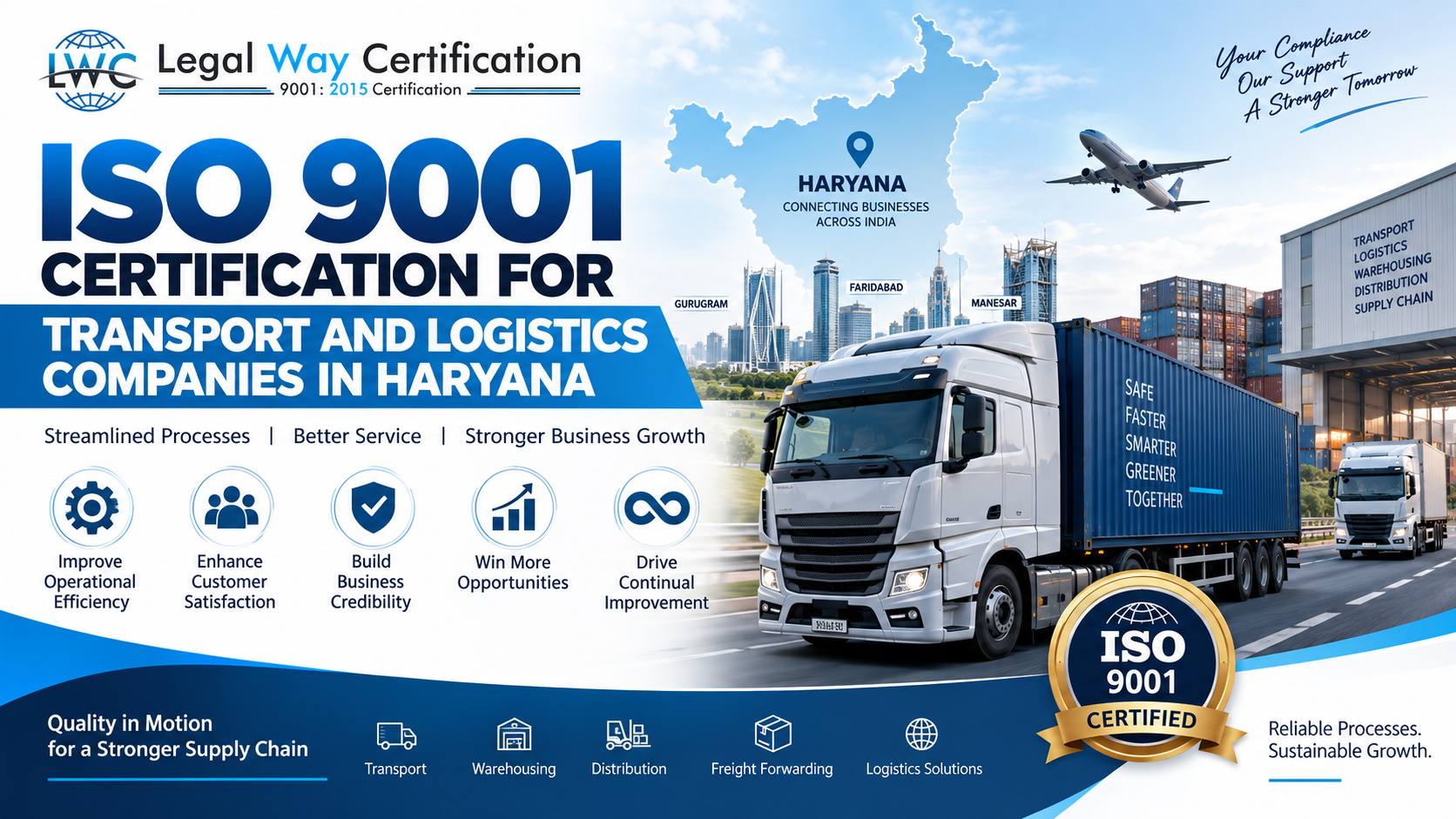
ISO 9001 Certification for Transport and Logistics Companies in Haryana provides a systematic framework for managing quality, customer requirements, operational processes, risks, responsibilities, performance and continual improvement.
The current standard is ISO 9001:2026, which was published by the International Organization for Standardization on 16 September 2026 and replaces ISO 9001:2015. The updated edition strengthens areas including leadership, quality culture, strategic alignment, risks and opportunities while retaining the established quality-management framework.
For businesses operating in Gurugram, Faridabad, Manesar, Sonipat, Panipat, Karnal, Rewari, Rohtak, Ambala and other parts of Haryana, ISO 9001 can provide a structured approach to improving and demonstrating the effectiveness of their quality-management processes.
ISO 9001 is an internationally recognized Quality Management System standard.
It is not a transport licence, vehicle certificate or statutory permission to operate a logistics business.
Instead, ISO 9001 provides requirements for establishing, implementing, maintaining and continually improving a QMS.
ISO confirms that ISO 9001:2026 is designed for organizations of different sizes, sectors and activities. The standard focuses on areas such as customer focus, process management, leadership, risk and opportunity management, quality culture and continual improvement.
For a logistics or transportation organization, the QMS can cover processes such as:
The exact certification scope should always reflect the organization's actual activities.
Transport and logistics businesses often operate through interconnected processes.
A customer order may pass through sales, operations, dispatch, transportation, warehousing, documentation, delivery and customer support. If one process is poorly controlled, it can affect the entire service.
ISO 9001 helps an organization look at these activities as connected processes rather than isolated departments.
A QMS helps businesses define responsibilities, establish process controls and monitor whether important activities are being performed consistently.
For example, a transport company can establish controlled procedures for:
Customer satisfaction is particularly important in logistics.
Customers expect their shipments to be handled according to agreed requirements.
A quality-management system can help organizations monitor customer requirements, complaints, service performance and opportunities for improvement.
ISO identifies customer confidence, complaint resolution, process improvement and continual optimization among the benefits associated with ISO 9001.
A professional QMS does not simply record that a problem occurred.
It encourages organizations to investigate the underlying cause and determine appropriate corrective action.
For example:
Problem: Repeated delivery delays.
Possible investigation: Is the cause route planning, vehicle availability, documentation, supplier dependency, communication or another operational factor?
Corrective action: Improve the relevant process and monitor whether the change is effective.
This process-oriented approach can be more valuable than simply reacting to individual complaints.
Many logistics companies work with:
A structured QMS can help organizations establish appropriate methods for evaluating, monitoring and reviewing external providers.
ISO 9001 certification can provide an independently assessed management-system credential that businesses may use when communicating their quality-management capabilities to customers and business partners.
However, certification should not be presented as a guarantee of perfect service or as automatic approval for every tender or contract. Specific customer and procurement requirements should always be checked.
One reason ISO 9001 is widely used is that its framework can be adapted to different organizational contexts.
Transport operators can establish QMS processes around:
Logistics companies can apply ISO 9001 to shipment coordination, warehouse operations, distribution, supplier management and customer service.
Freight forwarders can use structured processes for:
For warehouse businesses, relevant processes may include:
Third-party logistics companies can apply QMS principles across multiple outsourced logistics activities.
Courier companies can focus on:
Distribution businesses can use ISO 9001 to establish consistent processes for order processing, inventory coordination, transportation and customer service.
Because the current edition is ISO 9001:2026, businesses planning a new certification should work with the applicable current requirements rather than building a new system around outdated ISO 9001:2015 information.
ISO states that the 2026 edition maintains the established framework while providing greater emphasis on:
The updated standard also recognizes the increasing importance of interconnected supply chains, digital technologies and organizational resilience.
For logistics organizations, this is particularly relevant because modern transportation operations depend on interconnected suppliers, technology platforms, customers, warehouses and external service providers.
Obtaining certification should be approached as a management-system project rather than simply purchasing a certificate.
A practical certification journey can include the following stages.
The first step is to understand:
A properly defined scope prevents unnecessary confusion later.
A gap analysis compares the organization's existing processes with the applicable ISO 9001 requirements.
For a logistics company, this may involve reviewing:
The objective is to identify what already works and where improvement is required.
Legal Way Certification provides documentation support as part of its ISO consultancy services.
Depending on the organization, QMS documentation may include:
The documentation should be appropriate to the actual size and complexity of the organization.
More paperwork does not automatically mean a better QMS.
Documentation alone is not enough.
The organization needs to implement the relevant processes in daily operations.
Employees should understand:
This is especially important in logistics, where operational quality depends on coordination between different people and functions.
An internal audit helps the organization evaluate whether its QMS is being implemented effectively.
For a transport company, an internal audit may examine evidence relating to:
Legal Way Certification's Haryana service offering includes internal audit assistance, gap analysis, implementation support and audit preparation.
Management should review relevant QMS information and determine whether the system remains suitable and effective.
The review may consider:
This ensures quality management remains connected to business decision-making rather than becoming an isolated compliance activity.
The organization's QMS is then assessed through the applicable certification process by the certification body.
Certification is ultimately dependent on the applicable assessment and certification decision.
A certification body—not an ISO consultant—makes the certification decision.
This distinction is important for businesses comparing ISO 9001 certification companies in Haryana.
NABCB publishes information about accredited certification bodies and their management-system scopes, including ISO 9001 and the transport, storage and communication sector.
If nonconformities are identified, they need to be appropriately addressed according to the applicable certification process.
Once the certification requirements have been satisfactorily completed, the certification body makes the certification decision.
After certification, organizations should continue maintaining and improving their QMS.
The exact requirements depend on the organization's scope and operational complexity.
Common information may include:
For logistics businesses, additional operational evidence may involve:
A consultant should first understand the business before recommending the final documentation structure.
One of the most searched commercial queries is:
“What is the ISO 9001 certification cost in Haryana?”
There is no single price that accurately applies to every transport or logistics company.
The overall cost can depend on:
For example, a small local transport operator with one location may have a very different certification scope from a logistics company managing warehouses, multiple offices and extensive subcontractor networks.
Legal Way Certification offers customized ISO certification support and recommends assessing the actual business requirements before determining the appropriate certification approach.
The timeframe varies according to the organization's readiness, scope, documentation, implementation status and applicable certification arrangements.
A business that already has well-defined processes may require less preparation than an organization starting from scratch.
Instead of choosing a provider solely because it promises an unusually short timeline, businesses should ask:
A credible process should prioritize appropriate certification and evidence rather than simply promising a certificate in the shortest possible time.
ISO 9001 certification is not automatically mandatory for every transport or logistics company.
However, it can become a business requirement when a:
Therefore, companies should check the actual tender, contract or customer requirement instead of assuming that ISO 9001 is legally compulsory for all logistics businesses.
Legal Way Certification provides ISO certification support across Haryana and serves businesses in locations including:
Gurugram has a large concentration of corporate offices, logistics operations, service businesses and industrial activity.
Businesses can seek:
Relevant searches include:
For businesses operating in the industrial and logistics ecosystem:
Legal Way Certification can also support businesses seeking certification assistance in:
The certification scope should always be based on the organization's actual business activities, not simply its location.
ISO 9001 focuses on quality management, but some logistics businesses may also consider other standards depending on their activities.
Environmental management.
Occupational health and safety management.
Road traffic safety management.
Information security management.
For example, a logistics company managing large amounts of customer or shipment data may have information-security considerations in addition to quality-management requirements.
The appropriate standard depends on the organization's business model, risks, customer requirements and objectives.
Legal Way Certification's service model is designed around practical certification assistance rather than simply supplying generic documents.
Support can include:
This approach is particularly useful for logistics companies where the QMS needs to reflect real operational processes.
Legal Way Certification already positions its Haryana services around documentation, gap analysis, implementation, internal audit, training, certification-audit coordination and post-certification support.
Choosing an ISO 9001 Consultant in Haryana should involve more than comparing prices.
Before selecting a service provider, ask:
A logistics QMS is different from a manufacturing QMS.
Generic documentation may not accurately represent your transportation or logistics operations.
You should understand who provides consultancy and who performs the certification assessment.
A professional consultant should explain the assessment process instead of simply promising certificate issuance.
Maintaining a management system requires continued attention, particularly when surveillance or renewal activities apply.
The purpose of a QMS is to establish controlled and continually improving processes—not merely to obtain a framed certificate.
A procedure written for a manufacturing company may not be appropriate for a transport operator.
Employees need to understand processes relevant to their roles.
A QMS becomes more useful when the organization tracks meaningful quality and operational information.
The lowest quotation may not represent the most appropriate certification arrangement or level of consultancy support.
Repeated complaints or operational failures should be investigated rather than repeatedly treated as isolated incidents.
Yes. ISO 9001 is applicable to organizations across sectors, including service organizations. A transport company can establish a QMS appropriate to its activities and undergo the applicable certification process.
Potential benefits include more consistent processes, improved customer confidence, better complaint handling, stronger process control, structured corrective actions and continual improvement. The actual business benefits depend on how effectively the QMS is implemented.
The cost depends on the certification scope, employee strength, locations, operational complexity, existing QMS, audit requirements and certification arrangements. A customized quotation is therefore more meaningful than a universal price.
The typical journey involves defining the scope, conducting a gap assessment, developing or improving the QMS, implementing processes, preparing for internal audit and management review, undergoing the applicable certification assessment and addressing any identified nonconformities.
No, ISO 9001 is not automatically mandatory for every transport company. It may become a customer, tender or contractual requirement depending on the applicable business opportunity.
Your logistics business does not need a generic ISO template. It needs a quality-management approach that makes sense for the way your organization actually operates.
Whether you run a:
Legal Way Certification can help you understand the applicable requirements, prepare your QMS documentation, improve certification readiness and coordinate the certification process.
WhatsApp Chat: +91-9306445488
Phone: +91-9306445488
Contact Legal Way Certification to discuss your ISO 9001 Certification for Transport and Logistics Companies in Haryana, certification scope, documentation requirements and applicable process.
Start with a business-specific consultation rather than a one-size-fits-all certification package.
For transport and logistics companies, quality is directly connected with operational reliability, customer satisfaction and long-term business relationships.
A well-designed ISO 9001 Quality Management System can help organizations bring greater structure to processes such as transportation planning, shipment handling, customer communication, supplier management, complaint handling, performance monitoring and continual improvement.
For businesses in Haryana, ISO 9001 can also support a more professional approach to demonstrating quality-management practices to customers and business partners.
The current ISO 9001:2026 edition provides an updated framework that places stronger emphasis on leadership, quality culture, strategic alignment and risks and opportunities while retaining the established principles of quality management.
The key is to approach certification as a management-system improvement exercise—not simply as a document or certificate purchase.
If your transport or logistics company is planning certification, speak with Legal Way Certification for practical guidance on scope, documentation, implementation, audit preparation and certification coordination.
Call or WhatsApp +91-9306445488 to discuss your ISO 9001 requirements today.
ISO Stands for Legal way Certification. ISO is an independent, non-governmental international organization with a membership of 162 national standard bodies.
+91-9306445488 Enquiry Now© 2026 Legal Way Certification. All Rights Reserved