04 Sep 2026
Starting a business is only the first step. As a startup grows, customers, corporate buyers, investors and business partners increasingly want to know whether the company follows reliable and consistent processes.
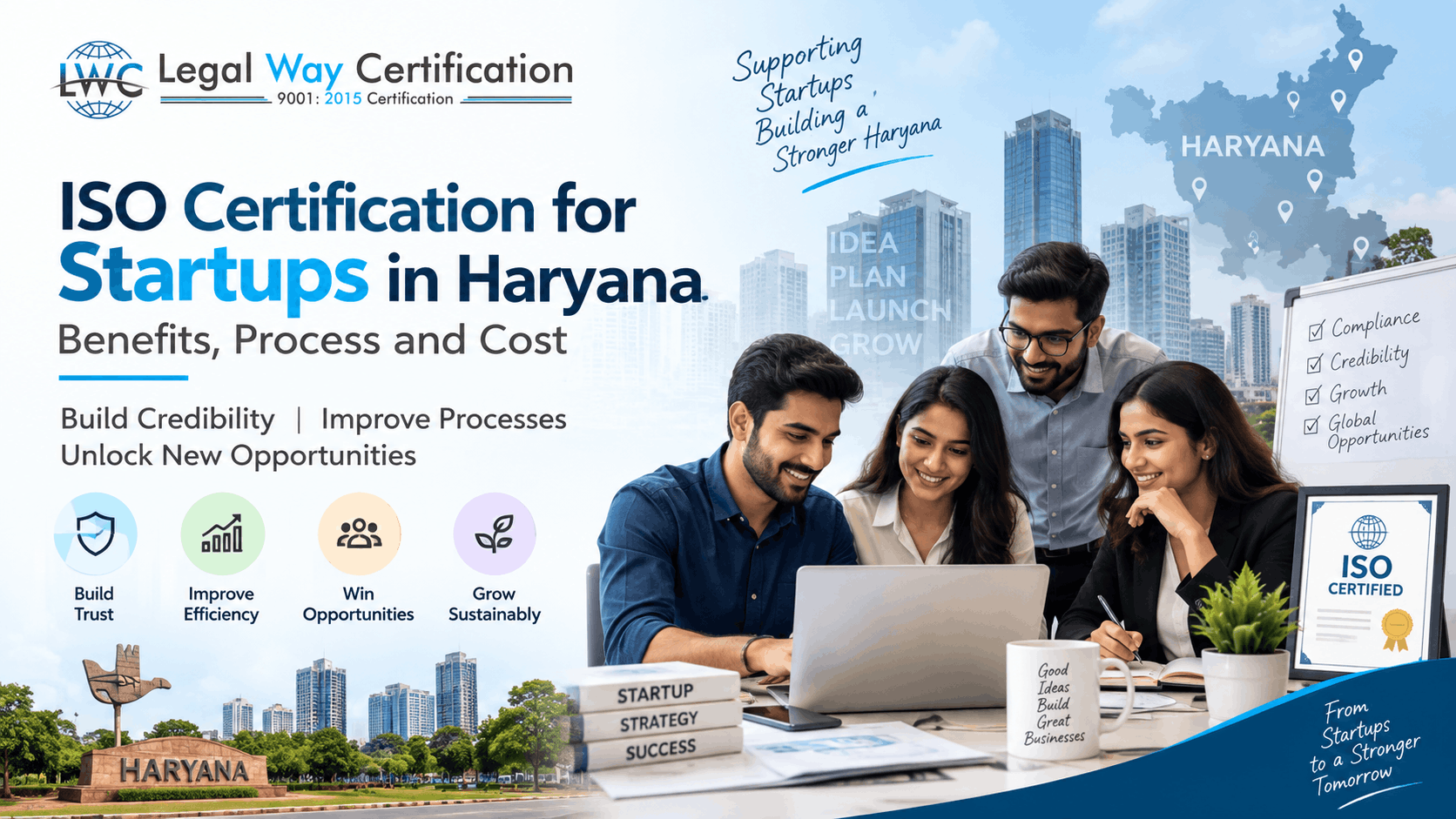
This is where ISO Certification for Startups in Haryana can make a meaningful difference.
ISO certification helps a startup establish a structured management system around areas such as quality, information security, food safety, environmental management or occupational health and safety. It can also strengthen business credibility when approaching larger customers or participating in opportunities where certification is part of the requirement.
For example, a software startup in Gurugram may consider ISO 27001 because it handles customer information, while a manufacturing startup in Faridabad may find ISO 9001 more relevant for quality management. A food-processing startup in Panipat may instead consider ISO 22000.
The right certification depends on what your startup does, what your customers expect and where you want to take the business.
ISO certification is an independent assessment of an organization's management system against the requirements of a particular ISO standard.
The International Organization for Standardization (ISO) develops international standards covering different areas of business and management. Certification itself is generally carried out by an independent certification body.
It is important to understand one common misconception:
There is no single “ISO certificate” that is suitable for every business.
Different standards address different business requirements.
Some commonly used standards include:
Therefore, startups should first identify the appropriate standard instead of choosing a certification simply because it is popular.
ISO certification is not automatically mandatory for every startup. However, it can provide practical business benefits when customers, contracts, tenders or industry requirements call for a structured management system.
A new company often has limited market history. An appropriately implemented and certified management system can help demonstrate that the organization follows defined processes.
This can be useful when approaching corporate clients, distributors, suppliers and institutional buyers.
Startups often operate with a small team where one person may handle several responsibilities.
As the business expands, informal processes can become difficult to control.
ISO-based systems encourage organizations to define responsibilities, document important processes, monitor performance and continually improve operations.
Customers want consistency.
Whether you manufacture components, provide software services or process food products, a systematic approach to quality and risk management can contribute to greater customer confidence.
A startup may begin with five employees and eventually grow into a much larger organization.
Creating scalable processes early can make expansion easier because responsibilities, workflows and controls are not dependent entirely on individual employees.
Large companies sometimes ask suppliers and service providers to demonstrate specific certifications or management-system capabilities.
Having the appropriate certification can therefore support supplier onboarding and business-to-business opportunities where certification is requested.
Some tenders or contracts may specify particular ISO certifications as eligibility or evaluation requirements.
However, startups should always check the exact tender document because ISO certification requirements differ from one opportunity to another.
There is no universal answer to this question.
The best ISO certification for a startup depends on its industry, operational risks, customer requirements and business objectives.
ISO 9001 certification is one of the most widely applicable management-system standards.
It focuses on quality management and areas such as:
It can be suitable for manufacturing companies, service businesses, trading organizations and many other startups.
A manufacturing startup in Faridabad supplying components to established companies may use ISO 9001 to establish consistent production and quality-control processes.
For software companies, SaaS providers, IT startups and businesses handling sensitive information, ISO 27001 certification may be highly relevant.
It focuses on an Information Security Management System (ISMS).
A startup dealing with customer information, business data, intellectual property or cloud-based systems may benefit from a structured information-security framework.
This is particularly relevant to the growing technology and IT business ecosystem in Gurugram and other parts of Haryana.
Food manufacturers, processors, restaurants, catering businesses and organizations involved in the food supply chain may consider ISO 22000 certification.
The standard focuses on food safety management and systematic control of food-safety risks.
Businesses whose operations have significant environmental impacts may consider ISO 14001 certification.
It provides a framework for managing environmental responsibilities and improving environmental performance.
Manufacturing, construction and other businesses with significant occupational health and safety risks may consider ISO 45001 certification.
The standard focuses on establishing a systematic approach to workplace health and safety.
The ISO certification process in Haryana generally involves several stages.
The exact process can vary depending on the selected standard, organization size, certification scope and certification arrangements.
Start by understanding your business requirements.
For example:
| Startup Type | Potentially Relevant Standard |
|---|---|
| Manufacturing startup | ISO 9001 |
| IT / SaaS startup | ISO 27001 |
| Food business | ISO 22000 |
| Environment-focused business | ISO 14001 |
| Construction / high-risk operations | ISO 45001 |
| Medical-device business | ISO 13485 |
This is only a general guide. The final standard should be determined according to the organization's actual requirements.
The scope explains which business activities, products, services and locations are covered by the management system.
A clearly defined scope prevents confusion during implementation and assessment.
The organization's existing practices are reviewed against the applicable ISO requirements.
This helps identify what needs to be developed, changed or improved.
Depending on the standard, the startup may need policies, procedures, objectives, records and other documented information.
The important point is that documentation should reflect actual business operations.
Creating documents that employees never use does not create an effective management system.
Employees should understand their responsibilities and follow the relevant processes.
For a startup, this can often be integrated into existing workflows instead of creating unnecessary layers of administration.
An internal audit can help identify gaps before the certification assessment.
It provides an opportunity to check whether the management system is implemented effectively.
Management reviews the performance and effectiveness of the system and identifies areas requiring attention or improvement.
An independent certification body assesses the management system against the relevant ISO standard.
If non-conformities are identified, appropriate corrective action may be required.
After the applicable requirements have been satisfactorily addressed, certification can be issued by the certification body.
The documents required for ISO certification depend on the selected standard and business scope.
Commonly required information may include:
Not every startup needs an enormous documentation system.
A good management system should be appropriate to the organization's size, activities, risks and complexity.
ISO certification cost in Haryana is one of the most searched questions by startups and MSMEs.
However, there is no single fixed price that applies to every organization.
The cost of ISO certification can depend on:
For example, a small single-location service startup may have a different certification requirement from a manufacturing company operating multiple facilities.
Don't compare providers only on advertised price.
Ask:
A transparent quotation should explain what is included.
The ISO certification timeline depends on the organization's size, standard, scope and level of preparation.
A small startup with straightforward operations may be able to prepare more quickly than a large organization with multiple departments and locations.
However, speed should not be the only objective.
The purpose of certification is to establish a management system that the organization can actually operate and maintain.
For most startups, ISO certification is not automatically mandatory simply because the business is a startup.
However, certification may become important when:
Always check the specific contractual, tender or regulatory requirement applicable to your business.
ISO certification is not restricted to large corporations.
ISO certification for MSMEs in Haryana can help small organizations introduce structured processes without waiting until they become large enterprises.
For an MSME, a properly implemented management system can help with:
A small organization does not necessarily need a complicated system. The management system should be proportional to the business.
Haryana has a diverse business ecosystem, including manufacturing, technology, services, logistics and food-related businesses.
Businesses searching for ISO certification in Haryana may also be located in major commercial and industrial areas such as:
Instead of treating every location as a separate certification requirement, businesses should focus first on their standard, scope and applicable requirements.
Choosing the right ISO certification provider is an important decision.
Before engaging an ISO certification consultant in Haryana, consider the following:
The provider should understand your business processes and the ISO standard relevant to your organization.
You should receive a clear explanation of documentation, implementation, assessment and certification.
Ask for a quotation that explains the scope of services and applicable costs.
Understand who is responsible for the certification assessment and how the certification process will be conducted.
Documentation should be relevant to your actual business rather than generic paperwork created only for certification.
New businesses sometimes make avoidable mistakes when applying for certification.
Don't select a standard only because another company has it.
ISO management systems are designed around processes and continual improvement. A certificate without meaningful implementation provides limited business value.
More documents do not automatically mean better compliance.
The cheapest quotation may not provide the level of support or certification arrangement your business actually requires.
Employees need to understand the processes relevant to their roles.
No, ISO certification is not automatically mandatory for every startup. Specific customers, tenders, contracts or industry requirements may require a particular certification.
It depends on the business. ISO 9001 is widely applicable for quality management, ISO 27001 is particularly relevant to information security, and ISO 22000 is commonly relevant to food-safety management.
The cost depends on the ISO standard, business size, scope, locations, operational complexity and certification assessment requirements. A customized quotation is therefore recommended.
Requirements vary by ISO standard. Common documentation includes organizational details, policies, objectives, process information, procedures and records relevant to the applicable management system.
A startup should identify the appropriate ISO standard, define its scope, prepare and implement the management system, conduct necessary audits and reviews, and undergo assessment by the applicable certification body.
Choosing ISO certification is easier when you understand which standard your startup actually needs and how the certification process works.
Legal Way Certification can help businesses understand their ISO certification requirements, documentation needs and certification process.
Whether you are a startup, MSME, manufacturer, IT company, food business or service provider in Haryana, the first step is to identify the certification that aligns with your business objectives.
📞 WhatsApp Chat: +91-9306445488
📞 Phone: +91-9306445488
Contact Legal Way Certification today to discuss your ISO certification requirements in Haryana.
For a startup, credibility and consistency can be just as important as growth.
ISO Certification for Startups in Haryana can help organizations build structured management practices, improve processes, strengthen customer confidence and prepare for larger business opportunities.
The key is not to obtain a certificate simply for the sake of having one. Choose the right ISO standard, understand its requirements, implement processes that genuinely fit your business and work with a transparent certification process.
If your startup or MSME is ready to explore ISO certification, contact Legal Way Certification at +91-9306445488 for professional assistance.
ISO Stands for Legal way Certification. ISO is an independent, non-governmental international organization with a membership of 162 national standard bodies.
+91-9306445488 Enquiry Now© 2026 Legal Way Certification. All Rights Reserved