22 Sep 2026
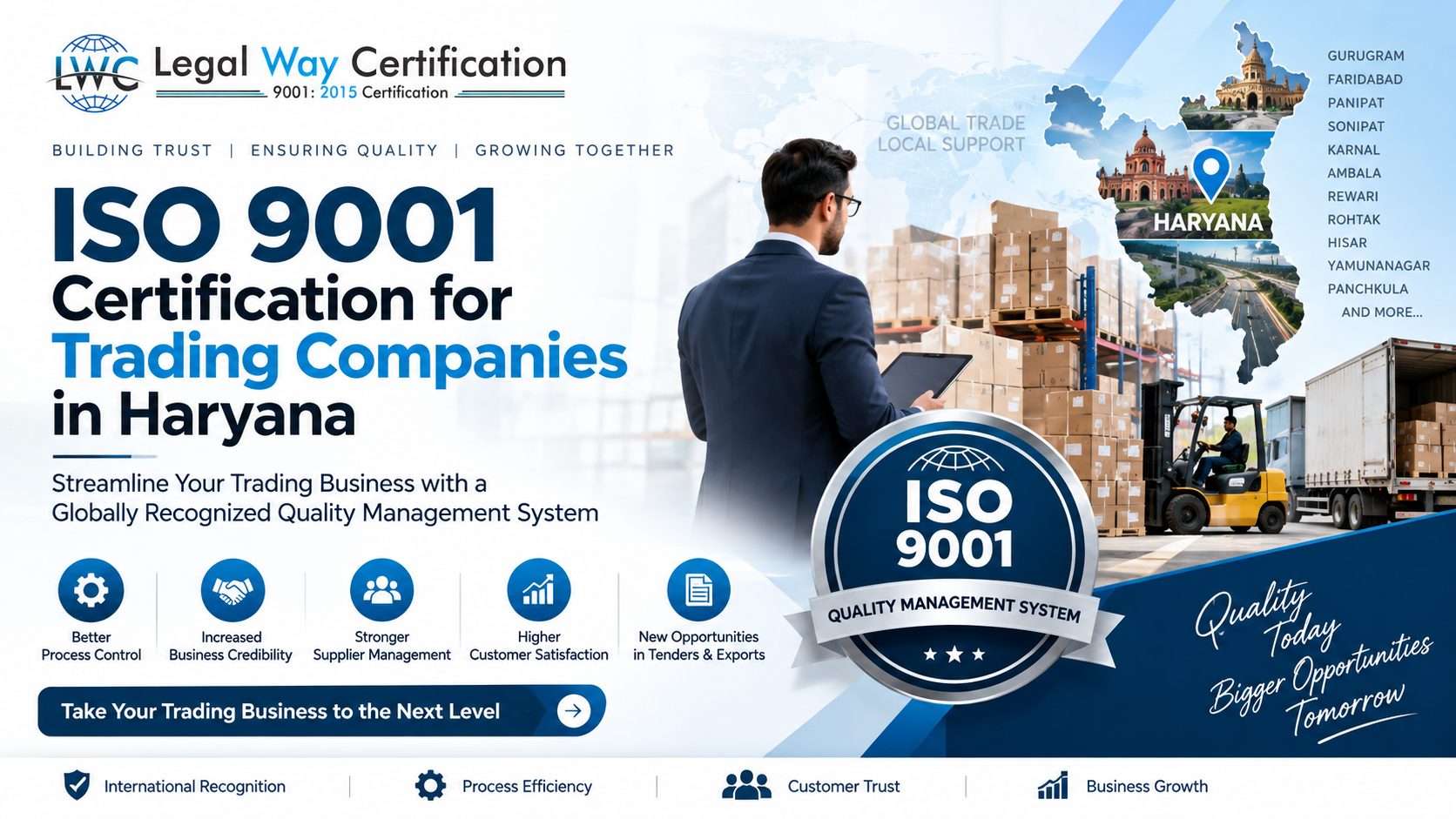
ISO 9001 Certification for Trading Companies in Haryana helps trading businesses establish a structured Quality Management System (QMS) for controlling purchasing, suppliers, customer requirements, order processing, inventory, delivery, complaints and continual improvement.
Trading companies may not manufacture products themselves, but they still play an important role in controlling product quality, supplier performance, documentation, customer communication and delivery. A well-designed ISO 9001 system helps a trading organization make these processes more consistent and measurable.
The latest edition of the standard is ISO 9001:2026, published by the International Organization for Standardization (ISO) on 16 September 2026. It replaces ISO 9001:2015 and places additional emphasis on leadership, quality culture, organizational context, risks and opportunities, and the effective integration of quality management into business operations.
For trading companies operating in Gurugram, Faridabad, Panipat, Sonipat, Karnal, Ambala, Rewari, Rohtak, Hisar, Panchkula, Yamunanagar and other parts of Haryana, ISO 9001 can provide a structured framework for managing business processes and demonstrating a commitment to consistent quality.
ISO 9001 is an internationally recognized standard for Quality Management Systems. It provides a framework for organizations to establish, implement, maintain and continually improve a QMS.
For a trading company, ISO 9001 does not mean that the company has to manufacture a product. Instead, the quality management system is designed around the organization's actual scope of activities.
Depending on the business, the QMS may cover:
ISO confirms that ISO 9001 can be applied by organizations of different sizes and sectors, making it suitable for trading businesses, distributors, wholesalers, suppliers and other commercial organizations.
A trading business often operates between suppliers and customers. Problems at any stage can affect delivery schedules, customer satisfaction and business reputation.
For example, a supplier may deliver the wrong specification, a purchase order may contain incomplete information, inventory may not be properly controlled, or a customer complaint may not be followed through to closure.
ISO 9001 provides a systematic approach to controlling these processes.
ISO itself identifies customer confidence, complaint resolution, process improvement and continual optimization among the benefits associated with ISO 9001.
The requirements should be interpreted according to the company's size, activities, risks and certification scope.
A trading company should not copy a manufacturing company's QMS simply to obtain certification. The system should reflect how the trading business actually works.
The company should have a controlled method for identifying and reviewing customer requirements before accepting an order.
This can include:
Supplier performance is particularly important for trading companies.
A suitable system may include supplier selection criteria, evaluation, approval, monitoring and periodic performance reviews.
Factors can include:
Purchasing controls help ensure that products and services are obtained according to defined requirements.
Purchase orders and related information should be clear enough for suppliers to understand what is required.
Where applicable, trading companies should control receiving, identification, storage, handling and dispatch.
This is especially relevant for businesses dealing with physical products, multiple SKUs, temperature-sensitive products, technical goods or regulated products.
A strong QMS should not merely record complaints. It should help the organization understand why a problem occurred and determine appropriate corrective action.
This creates a feedback loop between customer experience and process improvement.
The ISO 9001 certification process for trading companies generally involves several stages.
The organization first determines which business activities, locations, products or services will be included within the QMS.
For example:
“Trading and distribution of industrial electrical products”
may be more meaningful than using an unnecessarily broad or inaccurate scope.
The organization's current purchasing, sales, supplier management, inventory, customer service and administrative processes are reviewed.
This helps identify gaps between existing practices and applicable ISO 9001 requirements.
Relevant policies, procedures, controls and records are established according to the organization's actual operations.
Documentation should be practical. The objective is not to create unnecessary paperwork.
Employees need to understand the processes that apply to their responsibilities.
The QMS should become part of everyday operations rather than remaining only in a file prepared for an audit.
An internal audit evaluates whether the QMS has been implemented effectively and identifies areas requiring improvement.
Management reviews relevant performance information, customer feedback, audit findings, risks, opportunities and improvement requirements.
An independent certification body assesses the organization's QMS against the applicable ISO 9001 requirements.
ISO itself does not issue ISO 9001 certificates. Certification is carried out by independent certification bodies; accreditation can provide an additional layer of confidence regarding a certification body's competence.
After successful assessment and resolution of applicable findings, the certification body can issue the certificate.
Certification is not the end of the process. The organization must continue operating and improving its QMS and meet the applicable surveillance and certification requirements.
The exact documentation depends on the trading company's activities and scope.
Common information and records may include:
The important point is that documentation should support effective business control. A trading company does not benefit from maintaining complicated documents that employees do not actually use.
There is no universal ISO 9001 certification cost for every trading company in Haryana.
The final cost can vary depending on:
Therefore, businesses should obtain a quotation based on their actual scope rather than selecting a provider only because of a low advertised price.
For a reliable estimate, provide the certification provider with accurate information about your business activities, employee strength, locations and required standard.
ISO 9001 is relevant to more than traditional trading companies.
Wholesalers can use a QMS to control supplier selection, purchasing, stock management, order processing and customer service.
Distributors can focus on supplier controls, product handling, delivery performance, customer requirements and complaint management.
Businesses supplying products to other organizations may use ISO 9001 to demonstrate a structured approach to quality management and process control.
Importing businesses can establish controls around supplier approval, purchasing specifications, incoming products, documentation and customer requirements.
Export-oriented trading companies may use quality management controls around customer specifications, order review, supplier performance, documentation and delivery.
The appropriate certification scope should always reflect the organization's actual activities.
Trading companies sometimes search for ISO 9001 for government tenders, vendor registration and procurement opportunities.
ISO certification may be relevant where a particular tender, customer or vendor qualification process specifically requires or recognizes it.
However, ISO 9001 should not be presented as universally mandatory for all government tenders or all trading companies. Eligibility requirements depend on the specific tender, purchasing organization and contract.
Businesses should therefore review the exact tender or procurement documentation before assuming certification is compulsory.
Haryana has a large commercial and industrial ecosystem, creating demand for structured quality management among suppliers, distributors, traders and service organizations.
Businesses searching for:
should first identify their business scope and operational requirements.
A location-specific search should lead to a business-specific certification solution, not simply a duplicate city page with the same generic content.
The real value of ISO 9001 lies in connecting quality management with everyday business activities.
For example:
Supplier issue → Evaluation → Root-cause review → Corrective action → Performance monitoring → Improvement
Similarly:
Customer complaint → Complaint recording → Investigation → Corrective action → Customer response → Effectiveness review
This process-based approach can help management move from reactive problem-solving toward controlled and measurable improvement.
ISO 9001:2026 continues to emphasize customer focus, process-based management and continual improvement while strengthening areas such as leadership, quality culture and the consideration of risks and opportunities.
Businesses should be particularly careful about outdated online information.
ISO 9001:2026 is now the current edition, while ISO 9001:2015 has been withdrawn. Organizations currently certified to the previous edition should consult their certification body regarding applicable transition arrangements.
The 2026 edition retains the familiar management-system framework while introducing targeted updates for clearer application, stronger leadership and quality culture, and greater clarity around risks and opportunities.
This makes it important for a trading company beginning a new certification project in 2026 to discuss the applicable edition and certification arrangements with its certification body.
No. ISO 9001 certification is generally voluntary. However, a particular customer, contract, tender or vendor qualification process may specify ISO certification as a requirement or preference.
ISO 9001 is the primary quality management standard for organizations seeking certification of their Quality Management System. Other ISO standards may be relevant depending on the company's industry, products, information-security needs, environmental responsibilities or other requirements.
The cost depends on company size, locations, certification scope, business complexity, audit requirements and certification arrangements. A customized quotation should be obtained based on the organization's actual requirements.
Documents and records vary according to the company's QMS and scope. They can include the quality policy, objectives, supplier records, purchasing records, customer requirements, complaint records, internal audit records, management review information and corrective-action records.
The timeline varies according to the organization's size, scope, readiness, complexity and certification arrangements. A company with well-established processes may require less preparation than a business developing its QMS from the beginning.
Yes. ISO 9001 is designed for organizations of different sizes and sectors. The QMS should be proportionate to the organization's activities, risks, size and operational complexity.
It can help demonstrate a structured quality management approach where a customer or procurement process recognizes or requires ISO 9001. However, the exact vendor-registration requirements should always be checked with the relevant organization.
ISO 9001 Certification for Trading Companies in Haryana is more than obtaining a certificate. When implemented properly, it provides a structured framework for managing suppliers, purchasing, customer requirements, inventory, sales, delivery, complaints, risks and continual improvement.
For wholesalers, distributors, suppliers, importers, exporters and other trading organizations, the right QMS should be built around the company's real processes and certification scope.
If your business is planning ISO 9001 certification in Haryana, Legal Way Certification can assist with understanding the requirements, defining the certification scope, preparing documentation, implementing the QMS and preparing for the certification assessment.
Legal Way Certification
WhatsApp / Phone: +91-9306445488
Address: Ground Floor, Shop No. 11, EL-Commercia, PR 7 Road, Near Maya Garden City, Gate No. 3, Zirakpur, Punjab – 140603, India
Contact Legal Way Certification to discuss your trading company's requirements and get guidance based on your business activities, locations, employee strength and certification scope.
ISO Stands for Legal way Certification. ISO is an independent, non-governmental international organization with a membership of 162 national standard bodies.
+91-9306445488 Enquiry Now© 2026 Legal Way Certification. All Rights Reserved