01 Sep 2026
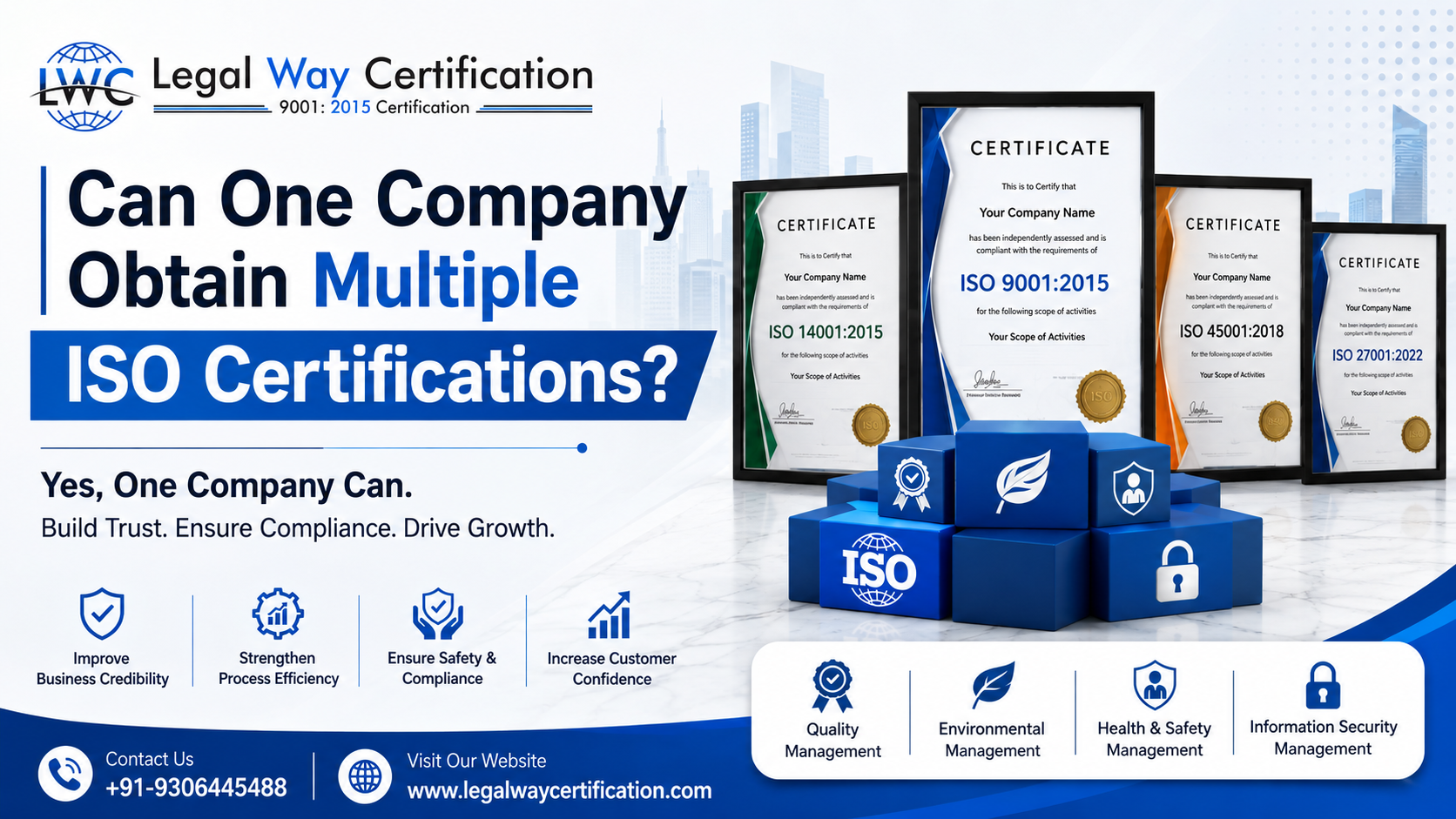
Yes, one company can obtain multiple ISO certifications. A business is not restricted to having only one ISO certification. If different ISO standards are relevant to its products, services, operations, customers, or industry requirements, the company can implement and maintain multiple management systems.
For example, a manufacturing company may require ISO 9001 Certification for quality management, ISO 14001 Certification for environmental management, and ISO 45001 Certification for occupational health and safety.
Similarly, an IT company may choose ISO 9001 along with ISO 27001 Certification to demonstrate both quality management and information security practices.
The important factor is not how many certifications a company has. The important factor is whether each ISO standard is genuinely relevant to the organization's activities and whether the company meets the applicable requirements.
For businesses looking for multiple ISO certifications in Haryana, combining relevant ISO standards can help improve operational systems, customer confidence, compliance management, and business credibility.
Yes. A company can have multiple ISO certifications at the same time.
Many businesses choose multiple ISO standards because one standard focuses on only one specific management area.
For example:
A company can implement two, three, or more standards depending on its business requirements.
In many cases, compatible standards can also be managed through an Integrated Management System (IMS). This can reduce duplication and make the overall management process more organized.
Multiple ISO certifications means that one organization has implemented and achieved certification for more than one applicable ISO management system standard.
Each certification demonstrates that the organization has established a management system for a particular business area.
For example, a company may hold:
This combination helps the organization manage quality, environmental responsibilities, and workplace safety through structured processes.
Another example could be a technology company with:
The right combination depends on the nature of the business.
Businesses today often manage several types of operational risks and responsibilities.
A company may need to improve product quality while also managing environmental impact, workplace safety, customer requirements, and information security.
One ISO standard may not address every requirement.
This is why many organizations choose multiple ISO certifications.
Multiple ISO certifications can demonstrate that a company follows structured management practices across different business areas.
This can improve confidence among customers, suppliers, business partners, and other stakeholders.
Some customers, corporate buyers, and tender opportunities may require businesses to meet specific management system requirements.
Depending on the industry, ISO certification may support eligibility requirements.
ISO management systems encourage organizations to establish structured procedures, monitor performance, manage risks, and identify opportunities for improvement.
Different ISO standards focus on different risks.
For example:
Multiple standards can help organizations manage these areas systematically.
For companies expanding into new markets or working with larger organizations, relevant ISO certifications can help demonstrate a commitment to recognized management practices.
A company can obtain different ISO certifications depending on its business activities.
Below are some common combinations.
This is one of the most popular combinations for businesses in manufacturing, engineering, construction, logistics, and industrial sectors.
ISO 9001 focuses on establishing a Quality Management System (QMS).
It helps organizations improve:
ISO 14001 focuses on an Environmental Management System (EMS).
It helps businesses identify and manage environmental aspects associated with their operations.
ISO 45001 focuses on an Occupational Health and Safety Management System (OHSMS).
It helps organizations manage workplace hazards and improve health and safety processes.
Together, these standards can create a strong management framework for quality, environmental responsibility, and workplace safety.
Yes. A company can obtain ISO 9001 and ISO 14001 certification together.
This combination can be useful for businesses that want to manage both quality and environmental performance.
Some management processes can often be coordinated, including:
However, the company must still address the individual requirements of both standards.
Yes.
Companies can implement ISO 9001 and ISO 45001 together when both quality management and occupational health and safety are important to their operations.
This combination can be particularly relevant for:
Businesses with operational or workplace risks may benefit from managing quality and safety through structured systems.
Yes. These three standards can often be implemented as part of an Integrated Management System.
The combination is commonly referred to as an integrated approach to:
An integrated approach can help businesses reduce unnecessary duplication.
For example, instead of conducting completely separate management reviews for every standard, an organization may coordinate the management process where the requirements are compatible.
The same principle can apply to internal audits, corrective actions, employee competence, and documented information.
An Integrated Management System (IMS) combines compatible management requirements from multiple ISO standards into one coordinated framework.
This does not mean every ISO standard becomes identical.
Instead, the organization identifies common requirements and manages them through shared processes where appropriate.
For example, several ISO management standards require organizations to address:
By coordinating these processes, businesses can manage multiple ISO certifications more efficiently.
Businesses seeking multiple ISO standards may benefit from an integrated approach.
Common procedures can sometimes be shared between compatible standards.
Management can monitor different performance areas through a coordinated system.
Audit activities can be planned efficiently where requirements overlap.
Employees may find it easier to work with coordinated procedures instead of multiple disconnected systems.
A structured system can help organizations identify risks, non-conformities, and opportunities across different business areas.
The process for obtaining multiple ISO certifications depends on the standards selected and the organization's business activities.
However, the general process usually includes the following steps.
The company should first identify which ISO standards are relevant.
Consider:
Choosing unnecessary certifications simply for marketing purposes may not provide meaningful value.
The best approach is to select standards that support genuine business requirements.
The organization should define the activities, products, services, and locations covered by the management system.
A clearly defined scope helps establish relevant procedures and responsibilities.
A gap analysis helps identify the difference between current business practices and the requirements of the selected ISO standards.
This process may identify areas requiring improvement, documentation, training, or operational controls.
The company develops the policies, procedures, records, and controls required for its selected standards.
When implementing multiple ISO standards, common processes may be integrated where appropriate.
ISO documentation alone is not enough.
The management system should be implemented within the actual business operations.
Employees should understand their responsibilities and follow applicable processes.
Internal audits help the organization review whether its management system is being followed and whether improvement is required.
Internal audit findings should be addressed through appropriate corrective actions.
The organization undergoes a certification assessment based on the applicable standard and certification scope.
The certification process evaluates whether the management system meets the applicable requirements.
Not necessarily.
Companies implementing compatible management standards may be able to coordinate audit activities.
For example, businesses implementing ISO 9001, ISO 14001, and ISO 45001 may have common management system processes that can be reviewed together.
A coordinated audit approach may help reduce:
The audit process depends on the standards, business scope, locations, and certification arrangements.
There is no general fixed limit on the number of ISO certifications a company can obtain.
A business can pursue multiple standards as long as they are relevant to its operations and the organization meets the requirements.
For example:
Possible certifications may include:
Possible certifications may include:
Possible certifications may include:
The best combination depends on the company's specific operations.
Haryana has businesses operating across sectors such as:
For these businesses, multiple ISO certifications in Haryana can support structured management practices across quality, safety, environmental responsibility, and other important business areas.
Companies should select ISO standards based on their actual industry and customer requirements.
For example, a manufacturing organization may benefit from ISO 9001, ISO 14001, and ISO 45001, while an IT company may prioritize ISO 9001 and ISO 27001.
A professional review of the organization's business activities can help identify the most suitable certification path.
The cost of multiple ISO certifications can vary.
Important factors include:
The cost should be evaluated based on the actual requirements of the organization.
Businesses should avoid selecting certification services only based on low pricing.
Understanding the scope and applicable requirements is important for selecting the right certification approach.
Implementing several ISO standards can involve different requirements, procedures, records, and management responsibilities.
Professional guidance can help businesses:
For businesses seeking ISO certification services in Haryana, choosing guidance based on business scope and industry requirements can make the certification journey more organized.
Legal Way Certification provides assistance and guidance for businesses exploring ISO certification options based on their industry and business requirements.
If your organization is considering multiple standards, you may need support in understanding the requirements of certifications such as:
The right certification combination depends on your business activities, customers, industry expectations, and management objectives.
WhatsApp Chat: +91-9306445488
Phone: +91-9306445488
Speak with the team to discuss your business requirements and understand which ISO certifications may be suitable for your organization.
Yes. A company can obtain multiple ISO certifications when different ISO standards are relevant to its business operations. Many organizations combine quality, environmental, safety, information security, or food safety management systems.
Yes. ISO 9001 and ISO 14001 can be implemented together. Businesses may coordinate common management processes such as document control, internal audits, management reviews, and corrective actions.
Yes. These standards can often be managed through an Integrated Management System. This approach can coordinate quality, environmental, and occupational health and safety management processes.
There is no fixed limit. A company can obtain multiple ISO certifications based on its industry, customer requirements, operational risks, and business objectives.
Multiple ISO certifications can help improve process management, customer confidence, risk management, operational consistency, workplace safety, environmental performance, and overall business credibility.
Yes, multiple ISO certifications can provide significant value when the selected standards are relevant to your business.
A company does not need to obtain every available ISO certification. Instead, it should choose standards that support its actual operations, customer expectations, industry requirements, and long-term business goals.
For example, ISO 9001, ISO 14001, and ISO 45001 may be suitable for a manufacturing or industrial business, while ISO 9001 and ISO 27001 may be more relevant for technology and information-based organizations.
The right approach is to understand your business requirements first and then select the appropriate ISO standards.
If you are looking for multiple ISO certifications in Haryana and want to understand which ISO standards may be suitable for your organization, contact Legal Way Certification for professional assistance.
📞 WhatsApp Chat: +91-9306445488
📞 Phone: +91-9306445488
Contact Legal Way Certification today and take the next step toward improving your organization's quality, compliance, safety, and business credibility.
ISO Stands for Legal way Certification. ISO is an independent, non-governmental international organization with a membership of 162 national standard bodies.
+91-9306445488 Enquiry Now© 2026 Legal Way Certification. All Rights Reserved