25 Jul 2026
Haryana has established itself as one of India's leading agricultural and industrial states, producing a wide range of export-quality products, including rice, wheat, spices, dairy products, honey, processed foods, herbal products, beverages, and packaged food items. As international trade continues to grow, exporters are expected to meet strict quality, safety, and ethical production standards before entering global markets.
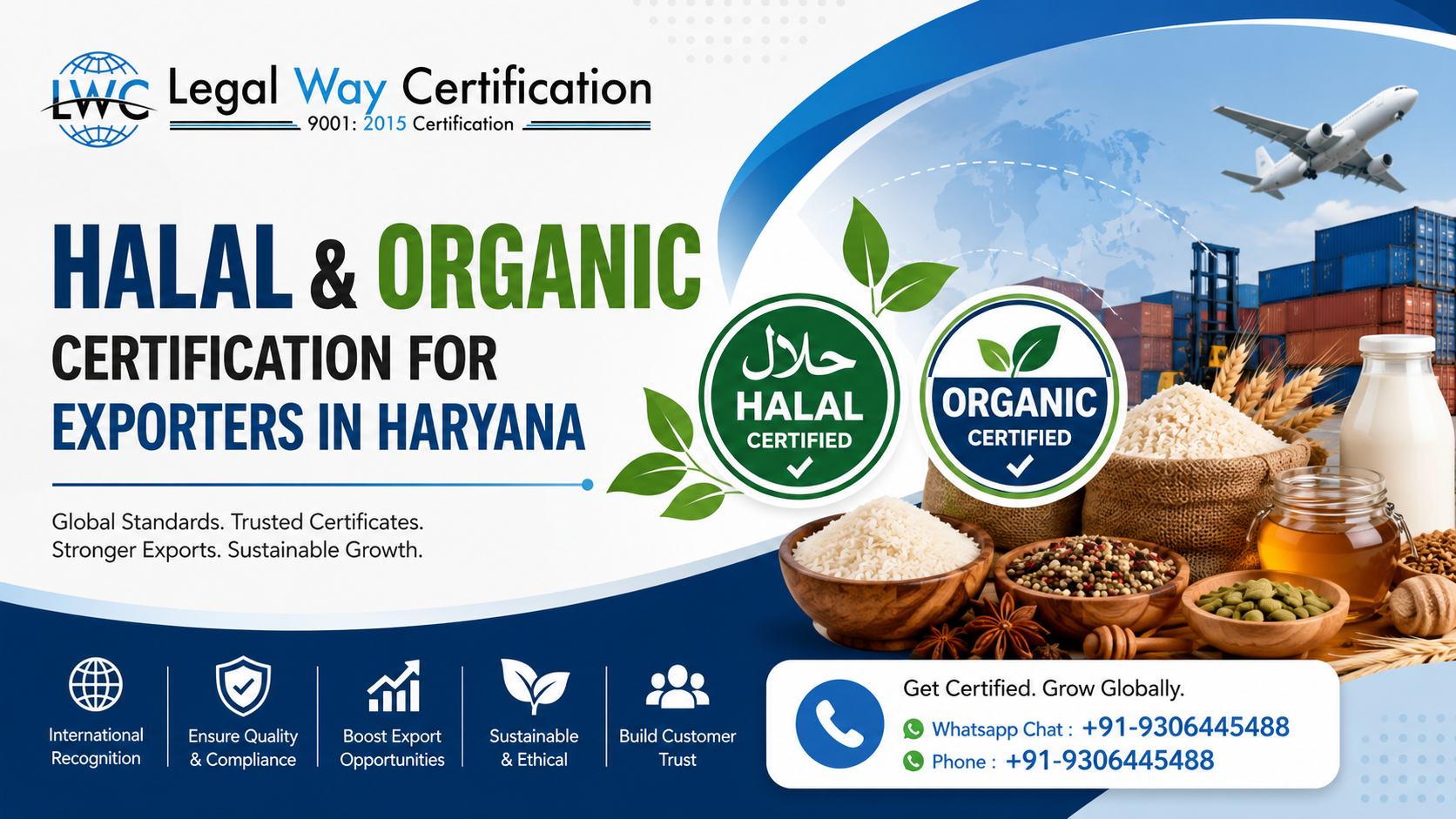
For businesses targeting countries in the Middle East, Southeast Asia, Europe, and other international markets, obtaining HALAL & Organic Certification for Exporters in Haryana has become more than a competitive advantage—it is often a business necessity. These certifications help demonstrate that products meet internationally accepted requirements for food safety, ethical production, traceability, and quality assurance.
Whether you are a food manufacturer, agricultural exporter, rice mill, spice exporter, dairy producer, or FMCG company, HALAL and Organic Certification can enhance your brand reputation, increase customer confidence, and unlock access to premium export markets.
At Legal Way Certification, we help exporters across Haryana obtain reliable certification through a transparent, efficient, and professionally managed process.
Global consumers are becoming increasingly conscious about the quality, origin, and manufacturing practices behind the products they purchase. Importers, retailers, supermarkets, and distributors often require internationally recognized certifications before approving new suppliers.
Businesses that obtain HALAL Certification in Haryana and Organic Certification in Haryana demonstrate that their products comply with internationally accepted standards related to food safety, hygiene, ethical sourcing, and environmentally responsible production.
These certifications not only improve customer trust but also make it easier for exporters to enter regulated international markets where certification is often expected or required.
Whether you manufacture packaged food, process agricultural products, or export consumer goods, certification strengthens your position in both domestic and international markets.
HALAL Certification confirms that products are prepared, processed, stored, and handled according to Islamic dietary guidelines. It is particularly important for businesses exporting food and related products to countries with significant Muslim populations.
A HALAL Certificate in Haryana is widely recognized by importers in markets such as:
Businesses involved in food manufacturing, beverages, dairy products, meat processing, confectionery, nutraceuticals, cosmetics, and pharmaceuticals often benefit from HALAL Certification when expanding internationally.
Organic Certification verifies that agricultural products and processed food items are produced using approved organic farming and manufacturing practices without prohibited synthetic chemicals, pesticides, or genetically modified ingredients.
For exporters, Organic Certification for Exporters demonstrates a commitment to sustainable agriculture, product traceability, and environmentally responsible production.
Products commonly requiring Organic Certification include:
As global demand for organic products continues to increase, certified exporters gain greater access to premium international markets and health-conscious consumers.
Many businesses assume they must choose between HALAL and Organic Certification. In reality, the two certifications serve different purposes and can complement each other.
For example:
Exporters who obtain both certifications strengthen their credibility among a broader customer base and improve acceptance in multiple international markets.
This is especially beneficial for exporters dealing in packaged food, spices, grains, dairy products, beverages, herbal supplements, and processed agricultural goods.
One of the biggest advantages of obtaining HALAL & Organic Certification for Exporters in Haryana is easier access to global buyers.
Many importers specifically look for suppliers that already hold internationally recognized certifications before initiating business discussions.
Certification assures buyers that your products are manufactured under controlled processes and meet recognized quality standards.
This builds long-term trust and strengthens your business relationships.
Consumers increasingly prefer brands that emphasize quality, transparency, sustainability, and ethical manufacturing.
Certified products enjoy greater credibility in retail stores, supermarkets, and export markets.
Many international buyers request certification documents during supplier evaluation.
Having the required certifications readily available can simplify export documentation and speed up approval processes.
When multiple suppliers offer similar products, certifications often become the deciding factor for buyers.
Businesses with HALAL and Organic Certification are better positioned to compete in international markets than those without recognized certifications.
These certifications are valuable for a wide range of industries across Haryana, including:
Whether you are a startup or an established exporter, obtaining certification demonstrates professionalism and prepares your business for long-term growth.
Many businesses think certification is only required to satisfy import regulations. In reality, HALAL and Organic Certification also improve internal business practices by encouraging better quality control, documentation, traceability, supplier management, and process consistency.
These improvements often lead to fewer customer complaints, stronger supply chain relationships, and enhanced operational efficiency.
For exporters aiming to build a sustainable global brand, certification is not just about compliance—it is about creating trust and long-term business value.
Obtaining HALAL & Organic Certification for Exporters in Haryana is a structured process that ensures your products comply with international quality, food safety, ethical production, and export standards. Partnering with an experienced certification consultant makes the journey easier while ensuring all documentation and compliance requirements are met efficiently.
The first step is understanding your business operations, products, export markets, manufacturing process, and certification requirements.
A professional certification consultant evaluates whether your business requires:
This assessment helps exporters choose the right certification strategy for their target markets.
Proper documentation is essential for successful certification.
Typical documents include:
Well-organized documentation speeds up the certification process and minimizes audit observations.
The certification team reviews your manufacturing facility to verify that products are manufactured, stored, packed, and handled according to applicable certification requirements.
The inspection generally focuses on:
For Organic Certification, additional verification may include farming practices, ingredient sourcing, and supply chain traceability.
If any gaps are identified during the review, corrective actions are recommended before the final certification audit.
These improvements may include:
Making these improvements helps ensure a successful certification outcome.
Once the organization is fully prepared, the certification body conducts the final audit.
The audit verifies:
After successful verification, the certification is approved.
Upon successful completion of the audit, your business receives the required certification.
You can proudly use your certification to:
Although documentation requirements vary depending on the product category and certification scope, exporters generally need:
Having complete documentation ensures faster certification and smoother audits.
One of the most frequently asked questions is:
"What is the cost of HALAL & Organic Certification in Haryana?"
The certification cost depends on several factors, including:
Instead of selecting the lowest-cost provider, businesses should focus on working with experienced consultants who offer complete guidance, transparent pricing, and ongoing compliance support.
Many exporters face unnecessary delays because of avoidable mistakes.
Low-cost certification services often provide limited documentation support and inadequate compliance guidance.
Missing supplier records, incomplete ingredient details, or inaccurate manufacturing information can delay certification.
International buyers increasingly demand complete traceability throughout the supply chain.
Maintaining proper records significantly improves buyer confidence.
Many exporters begin the certification process only after receiving a purchase order.
Obtaining certification in advance allows businesses to respond more quickly to international opportunities.
Certification is not a one-time activity. Regular compliance, surveillance audits, and updated documentation help maintain credibility and ensure uninterrupted export operations.
At Legal Way Certification, we help exporters across Haryana obtain internationally recognized certifications with complete transparency and professional support.
We work with:
Our experienced consultants simplify the certification process so you can focus on growing your export business.
HALAL Certification verifies that products are manufactured, processed, and handled according to Islamic dietary requirements. It helps exporters access markets in the Middle East, Southeast Asia, and other regions where HALAL-certified products are preferred or required.
Organic Certification confirms that agricultural and food products are produced following approved organic farming and processing practices. It enhances consumer trust and supports exports to markets that value sustainable and chemical-free products.
Yes. Many exporters obtain both certifications to meet the requirements of diverse international buyers and strengthen their presence in global markets.
The timeline depends on product type, documentation readiness, facility compliance, and audit scheduling. Working with an experienced consultant helps streamline the process.
Food manufacturers, rice mills, spice exporters, dairy processors, honey producers, beverage manufacturers, agricultural exporters, organic food companies, and FMCG businesses can all benefit from these certifications.
As global demand for certified food and agricultural products continues to grow, HALAL & Organic Certification for Exporters in Haryana has become a valuable investment for businesses seeking long-term success in international markets. These certifications not only improve compliance with global standards but also strengthen customer confidence, enhance brand reputation, and open doors to premium export opportunities.
Whether you export rice, spices, dairy products, honey, processed foods, herbal products, beverages, or other agricultural goods, obtaining the right certifications demonstrates your commitment to quality, ethical practices, and sustainable production.
With expert guidance from Legal Way Certification, you can navigate the certification process smoothly and prepare your business for long-term growth in competitive global markets.
Ready to expand your export business with internationally recognized certifications?
Our experienced consultants provide end-to-end support for HALAL Certification, Organic Certification, documentation, audit preparation, and compliance assistance.
📞 WhatsApp Chat: +91-9306445488
📞 Phone: +91-9306445488
Contact Legal Way Certification today to discuss your certification requirements and take the next step toward building a trusted, export-ready business with globally recognized HALAL and Organic certifications.
ISO Stands for Legal way Certification. ISO is an independent, non-governmental international organization with a membership of 162 national standard bodies.
+91-9306445488 Enquiry Now© 2026 Legal Way Certification. All Rights Reserved